

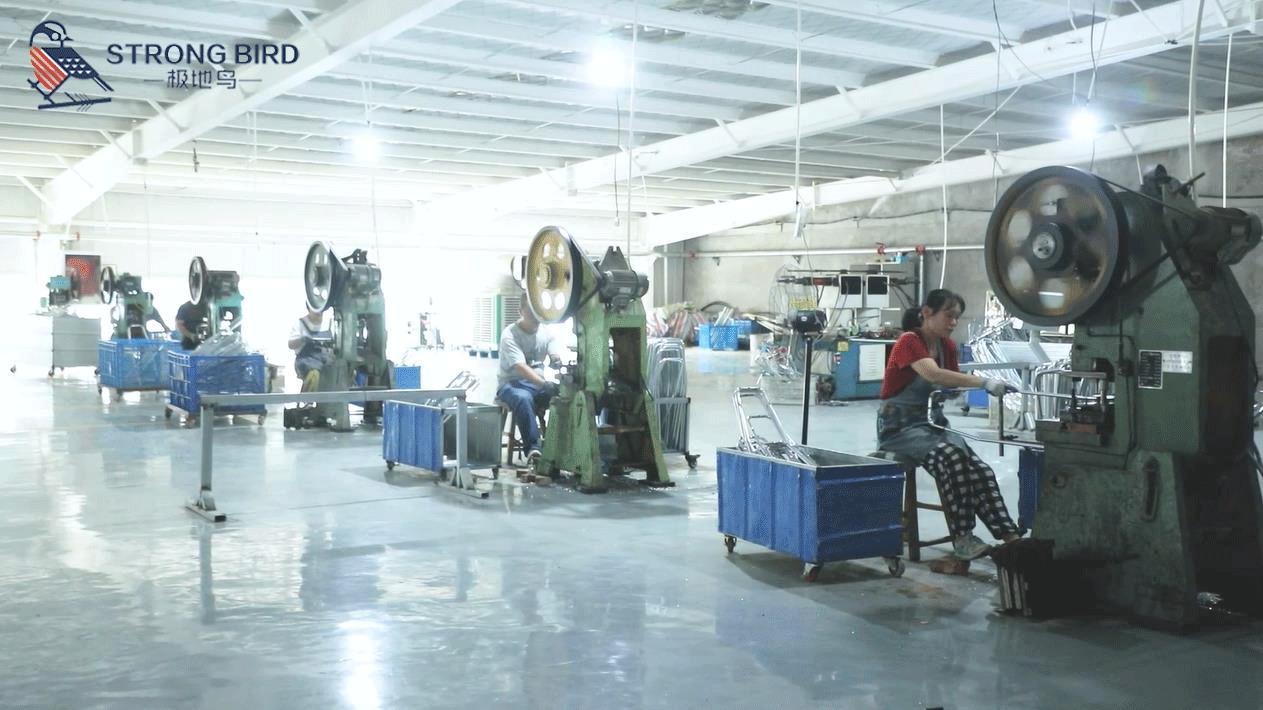
Overview of the OEM Shopping Cart Manufacturing Process
When working with a trolley manufacturing, many international buyers initially assume the process is simple production.
In reality, the shopping cart manufacturing process is a structured engineering system that connects user requirements, structural design, material selection, and production consistency.
This is especially important for custom shopping carts, where small differences in usage scenarios can significantly impact engineering decisions.
Core OEM workflow:
| Stage | Function |
|---|---|
| Requirement analysis | Define real usage scenarios |
| Engineering design | Convert needs into structure |
| Sampling | Validate performance |
| Mass production | Scale manufacturing |
| Quality control | Ensure consistency |
| Shipping | Protect export delivery |
Step 1 – Requirement Analysis for Custom Shopping Carts
This stage defines the foundation of the entire engineering process.
A professional Custom shopping cart manufacturer does not start with drawings—it starts with understanding how the product will be used in real environments.
Typical application scenarios:
- Retail supermarket operations
- Warehouse logistics handling
- Urban household grocery transport
- Corporate gifting and employee welfare programs
- Community distribution and public service projects
- Seasonal promotional campaigns
Key requirement inputs:
- Load capacity expectation
- Usage frequency (daily / occasional / seasonal)
- Storage environment constraints
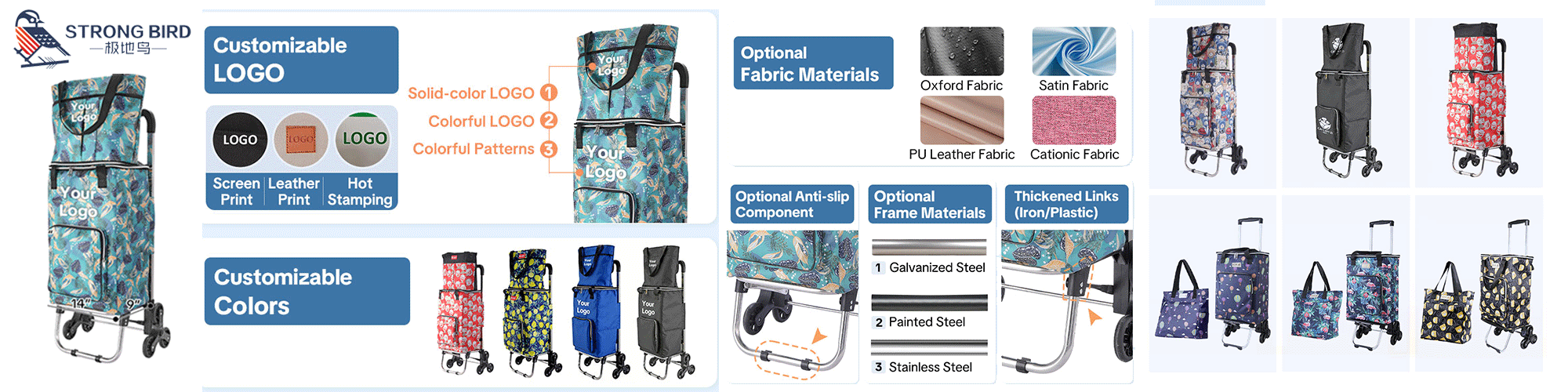
- Branding and OEM customization needs
- User type (consumer / logistics / elderly / staff)
Clear requirement definition directly determines engineering efficiency and product reliability.
Step 2 – Engineering Design and Structural Development
This is where a real shopping cart supply chain converts requirements into a functional engineering system.
At this stage, engineers focus on structural logic such as load distribution, material selection, and mechanical stability.
Different usage requirements naturally lead to different structural configurations, for example:
- A standard folding structure for lightweight mobility-focused carts
- A reinforced multi-wheel configuration for stair-transport applications
- A seat-integrated structure for extended-use and stability-focused scenarios
These configurations are not “product categories”, but engineering responses to real-world usage requirements.
Core engineering focus:
- Structural load distribution
- Frame material selection (steel / aluminum alloy)
- Folding mechanism stability
- Wheel system performance design
Key factory insight:
The engineering challenge is not selecting a product type, but ensuring each configuration maintains structural stability under real operational stress.
Step 3 – Prototype Sampling and Performance Testing
This is the validation stage where engineering is tested against reality.
A qualified shopping cart manufacturing process is defined by measurable performance standards rather than appearance approval.
Engineering performance standards:
| Component | Test Focus | Qualified Standard | Failure Risk |
|---|---|---|---|
| Frame structure | Load & deformation resistance | No deformation under rated load + stable geometry after stress cycles | Structural bending |
| Welding points | Joint fatigue resistance | No cracking after vibration + load cycles | Long-term failure |
| Wheel system | Mobility stability | Smooth rolling under full load + no wobble | Transport instability |
| Folding mechanism | Cycle durability | Stable locking after 1,000–2,000 folds | Safety risk |
| Handle system | Force stability | No bending under pulling load | Handle failure |
| Basket / bag system | Material strength & integrity | Tear-resistant, no sagging, stable attachment | Fabric failure |
All components are tested as a complete system under combined stress conditions, not in isolation.
Step 4 – Mass Production in a China Shopping Cart Factory
Once validated, production moves into a OEM shopping cart factory environment.
At this stage, the focus shifts from design precision to manufacturing consistency.
Production process includes:
- Steel cutting and forming
- Welding and structural assembly
- Surface finishing and coating
- Component installation
- Pre-shipment inspection
Producing one stable prototype is relatively simple.
Producing thousands of identical units is where real manufacturing capability is tested.
Step 5 – Quality Control System (IQC / IPQC / FQC)
Quality control is a continuous engineering safeguard rather than a final checkpoint in the shopping cart manufacturing process.
It ensures consistency, structural reliability, and production stability across every batch from a shopping cart manufacturer.
QC System Overview
| Stage | Focus Area | What It Prevents | Engineering Value |
|---|---|---|---|
| IQC (Incoming Quality Control) | Raw material verification (steel, wheels, fabric, components) | Substandard materials entering production | Ensures baseline structural quality |
| IPQC (In-Process Quality Control) | Welding, assembly, and production monitoring | Welding defects, assembly deviations, structural inconsistency | Prevents batch-level variation during manufacturing |
| FQC (Final Quality Control) | Finished product inspection before shipment | Functional failure, structural instability, cosmetic defects | Ensures export-ready product consistency |
Quality control is not about “finding problems at the end”, but about preventing instability from entering the production system in the first place.
Step 6 – Packaging and International Shipping
At this stage, engineering transitions into logistics protection.
Key considerations
- Protect folding structure integrity
- Prevent wheel deformation
- Optimize container loading
- Reduce vibration damage during transport
Packaging directly impacts final delivery condition.

How to Choose a Reliable Shopping Cart Manufacturer in China
From 20+ years of factory experience, buyers who succeed long-term always evaluate suppliers based on system capability—not price.
Key evaluation criteria
- In-house production capability
- OEM/ODM engineering support
- QC transparency
- Export experience (US/EU markets)
- Customization flexibility
StrongBird Manufacturing Capability
At StrongBird, we focus on long-term stability in the shopping cart manufacturing process.
We support:
- Engineering-driven development for custom shopping carts
- OEM branding and packaging customization
- Scalable mass production
- Consistent quality control systems
Final Thoughts
The shopping trolley manufacturing process is not a production sequence—it is an engineering system.
For buyers, the real difference between suppliers lies in how they design, test, and control structural consistency.
Ultimately, the quality of custom shopping carts is determined long before mass production begins.
Related Reading
The shopping cart manufacturing process is closely related to material selection, which directly affects product durability and structural performance.
👉 Learn more about shopping cart materials:
https://strongbirdcart.com/blogs/news/shopping-cartsf-materials


.png?w=1456&h=720)