

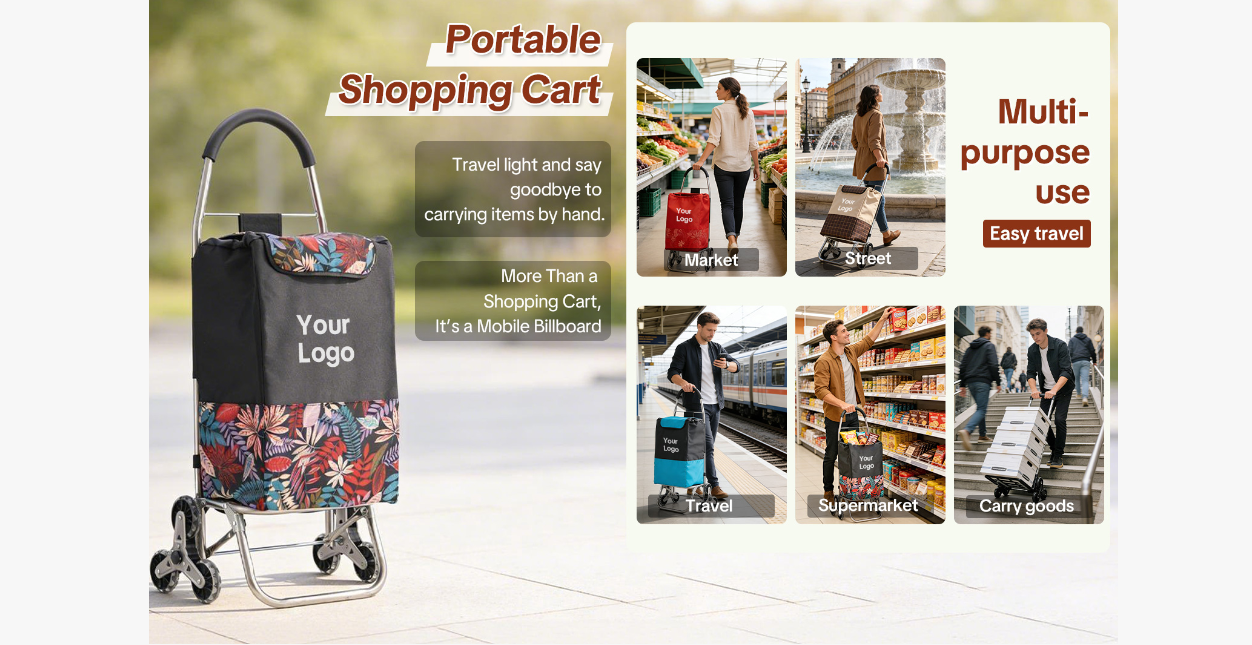
When businesses search for a custom shopping cart, they are usually looking for more than a product with a logo.
A successful custom project requires a clear understanding of user needs, application environments, product design, and manufacturing capability.
The goal of customization is not simply to create a different-looking cart. It is to develop a solution that works better for a specific market.
What Is a Custom Shopping Cart
A custom shopping cart is a product developed or modified based on specific business requirements, user scenarios, or brand goals.
Unlike standard models, custom carts may involve changes in structure, materials, functions, size, and branding.
For example, a retailer may need a lightweight folding cart for urban customers, while a community project may require a more stable solution for senior users.
Customization is valuable because different markets have different problems to solve.
Why Businesses Need Custom Shopping Carts
A standard shopping cart may work well in general environments, but some applications require specialized designs.
Businesses choose custom shopping carts to:
- Improve user convenience
- Support specific customer groups
- Create product differentiation
- Match local market expectations
- Develop solutions for unique environments
The right cart is not the one with the most features. It is the one that best matches the actual usage scenario.
What Can Be Customized
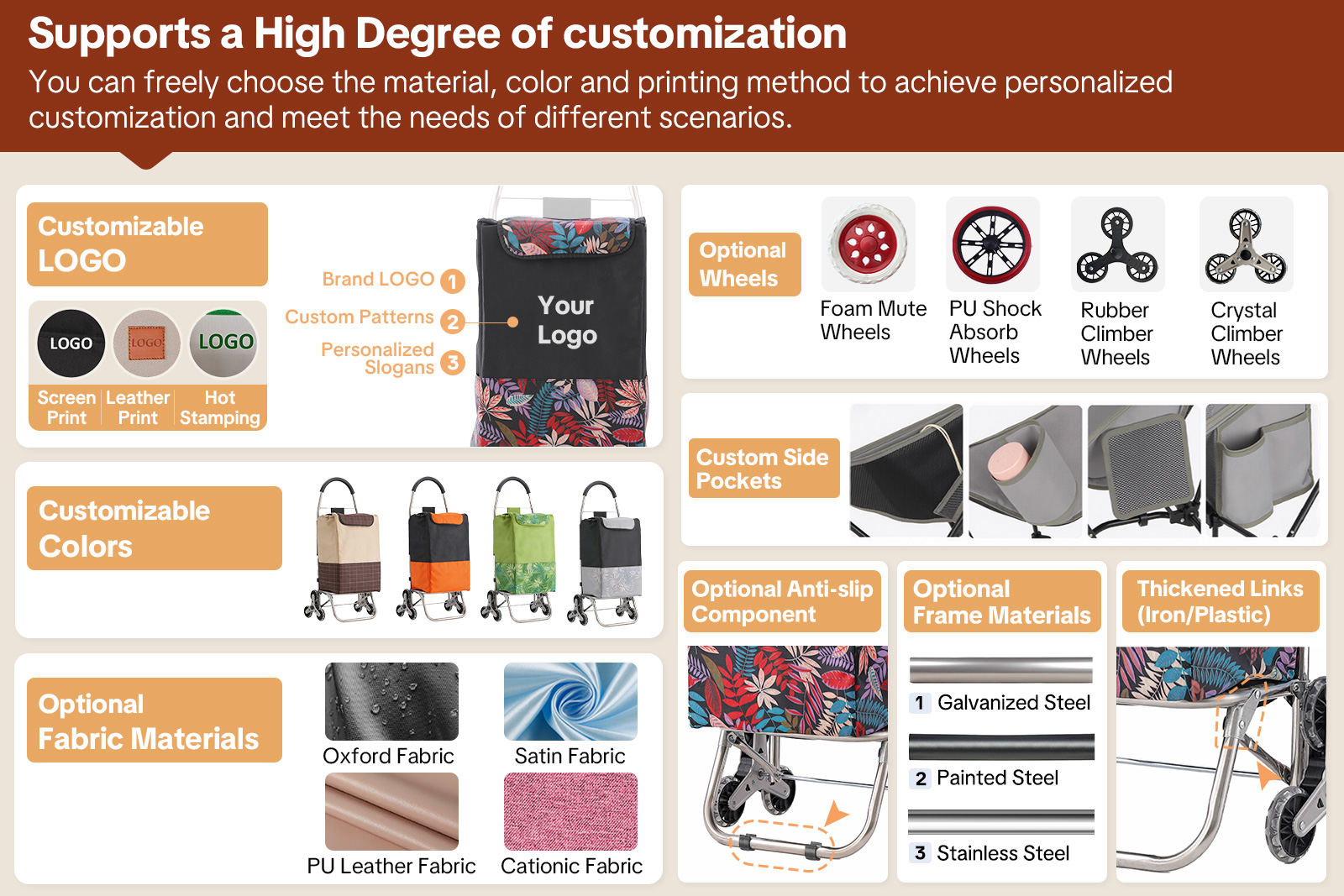
Professional shopping cart customization involves much more than adding a logo.
| Customization Area | Possible Options | Business Value |
|---|---|---|
| Structure & Function | Frame design, folding system, handle, wheel system | Improves usability and application performance |
| Capacity & Performance | Size, load capacity, stability | Matches different user requirements |
| Materials | Fabric, metal thickness, wheel materials | Improves durability and product lifespan |
| Branding | Logo, colors, packaging | Builds brand recognition |
| Special Features | Seat, stair climbing function, storage options | Creates solutions for specific markets |
A professional manufacturer helps balance design goals, production feasibility, cost, and long-term performance.
How to Design a Successful Custom Shopping Cart
Many custom projects fail because buyers focus only on appearance.
A reliable custom shopping cart manufacturer usually starts with several key questions:
- Who will use the cart?
- Where will it be used?
- What problem should it solve?
- What performance standards are required?
| Design Factor | Key Questions | Impact on Product |
|---|---|---|
| Target Users | Who is the end user? | Determines comfort and usability |
| Usage Environment | Indoor, outdoor, stairs, retail, warehouse? | Defines structure and wheel requirements |
| Product Function | What problem needs solving? | Determines necessary features |
| Material Selection | What durability level is needed? | Affects lifespan and cost |
| Manufacturing Feasibility | Can it be produced consistently? | Ensures stable bulk production |
Good custom cart design is not about adding complexity. It is about making the right engineering decisions.
Common Mistakes in Custom Cart Projects
During custom projects, buyers often face several challenges:
Designing before understanding the application
Without clear user requirements, customization may increase cost without improving performance.
Focusing only on appearance
A visually attractive cart may still fail if the structure, wheels, or materials cannot support daily use.
Ignoring mass production capability
A successful sample does not always guarantee consistent bulk production. An experienced OEM shopping cart partner should be able to maintain the same quality standard from prototype to final shipment.
How to Select the Right Manufacturer
Choosing a shopping cart supplier is not only about price.
Businesses should evaluate:
- Manufacturing experience
- Engineering support capability
- Quality control system
- OEM development experience
- Communication and project management ability
A capable manufacturer should help transform an idea into a practical product solution.
StrongBird supports global customers with custom shopping cart development, engineering evaluation, and controlled manufacturing processes.
The success of a custom project depends on choosing the right design approach and the right manufacturing partner.
A custom project requires more than production capacity. Buyers should evaluate whether a manufacturer has engineering capability, quality control systems, and experience handling bulk production.
Before starting a custom shopping cart project, understanding how to evaluate a reliable manufacturer can help reduce production risks.
Learn more:


.png?w=1456&h=720)